Partnership Prospectus
Updated on: 08/05/2026
Executive Summary
Heliciculture (snail farming) — sits at the intersection of four converging markets: gourmet food, clean-beauty cosmetics and pharmaceutical research, regenerative-agriculture biofertilizer, and a small but real education and companion-animal niche. Independent industry research values these markets, combined, in the billions of dollars today and projects sustained double-digit growth in several segments through the early 2030s.
The constraint holding the industry back is not demand — it is production: snail farming has remained largely artisanal, land-intensive, and, in the United States, complicated by the species' USDA APHIS invasive-pest classification.
EscarGrow Pro and EscarGrow Mini are patent-pending, sealed systems designed to solve that production problem. Rather than retrofitting compliance onto an open-air farm, EscarGrow is engineered from the ground up as a contained, monitorable environment — built around the regulatory reality of heliciculture in the U.S..
EscarGrow is currently at the prototype stage of development, with hardware engineering led by industrial designer Oleg. In its 2025, EscarGrow was named an EarthShot Prize nominee.
This prospectus lays out the market opportunity, the technology, an illustrative unit-economics and revenue model, the regulatory landscape that shapes the entire industry, and the specific ways manufacturing partners, distribution partners, land and farm-operator partners, institutional partners, and capital partners can plug into this ecosystem
The Opportunity
Snail farming is one of the few animal-protein systems that scales down environmental cost as it scales up production. Snails are ectothermic, require minimal water, and convert low-grade feed (including vegetable byproducts) into protein at a fraction of the carbon footprint of conventional livestock: producing one kilogram of snail meat is estimated to emit roughly 0.7 kg of CO₂, compared with 5–6 kg for poultry and up to 18 kg for beef.
Source: Lampoon Magazine, “Inside a Global Boom of Snail Mucin in Beauty,” Oct. 2025, citing industry lifecycle comparisons.
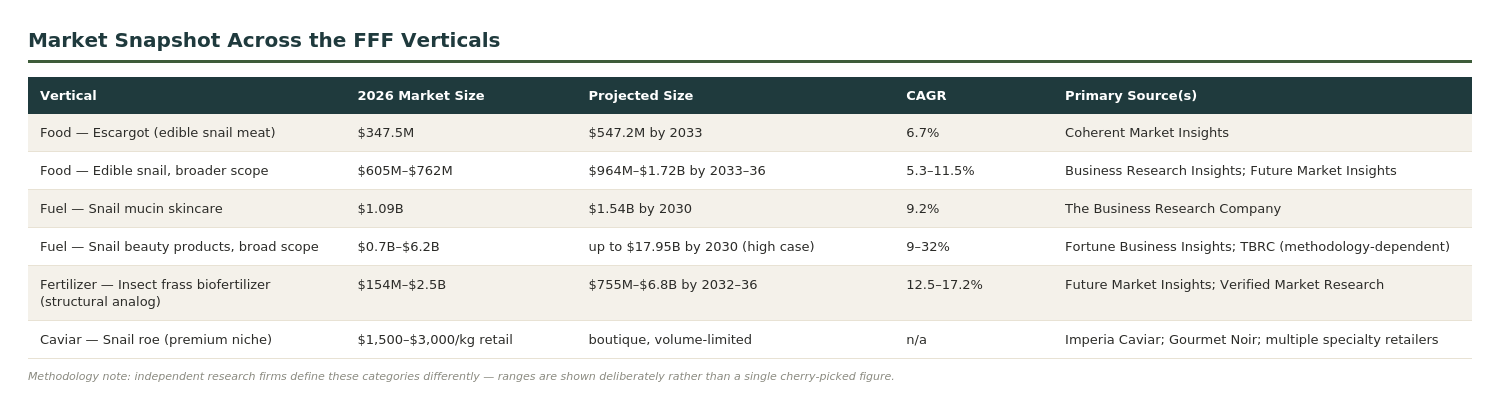
At the same time, three adjacent markets have discovered uses for what a snail farm produces beyond meat: the K-beauty-driven snail mucin skincare boom, the rapidly professionalizing insect/invertebrate frass biofertilizer category, and a deep bench of peer-reviewed pharmaceutical research into snail mucin's wound-healing and antimicrobial properties. Below is a snapshot of how independent research firms currently size each of these markets.
2. Market Deep Dive
2.1 Food: Escargot & the Culinary Delicacy Market
Roughly 450,000 metric tons of edible snails are harvested and traded globally each year. France alone consumes about 30,000 metric tons annually and lists escargot on menus at more than 25,000 restaurants; Nigeria and Ghana together contribute over 65,000 metric tons, largely from wild harvest; Vietnam's farmed output exceeds 20,000 metric tons a year. Snail meat carries roughly 16.5 g of protein and under 1.4 g of fat per 100 g, positioning it squarely inside the high-protein, low-fat demand curve that is reshaping global menus.
Source: Market Growth Reports, “Edible Snail Market Size & Industry Report,” 2026.
Pricing varies enormously by channel and geography. Irish farmgate prices for fully grown snails run about €4–€4.50/kg. U.S. direct-to-restaurant sales command roughly $30–$60/lb, and a blended U.S. small-farm model (mixing retail, restaurant, and processed-product channels) nets closer to $40/lb. The clearest margin opportunity, according to industry analysts, is not in live-snail commodity sales but in processed, ready-to-cook, and canned product — exactly the channel that stays within USDA APHIS's permitted-sale pathway for this species.
Source: The Irish Farmers Journal, Jan. 2023; Financial Models Lab, “Sales Volume, Margins and Take-Home Pay Inside Snail Farming,” 2026; Future Market Insights, “Snail Market,” 2026.
2.2 Fuel: Snail Mucin — Cosmetics, Pharma & Beyond
Snail mucin has gone from a niche Korean skincare ingredient to a mainstream clean-beauty staple carried by brands like COSRX, Mizon, and Dr. Jart+. The value spread across the mucin supply chain is dramatic: bulk cosmetic-grade mucin powder trades wholesale for single-digit dollars per unit from commodity Chinese suppliers, while ethically-extracted, high-purity freeze-dried concentrate from specialty producers such as Aden International has sold for as much as $58,200 per kilogram (a price that outpaces gold). That spread is the whole investment thesis for this vertical: the money is in traceable, high-purity, cruelty-free extraction, not in commodity raw material.
Source: Lampoon Magazine, Oct. 2025; Made-in-China.com supplier listings, 2026.
Beyond cosmetics, a growing body of peer-reviewed research (ScienceDirect, Nature Index, and multiple pharmaceutical-sciences journals) documents snail mucin's antimicrobial, anti-inflammatory, wound-healing, and drug-delivery properties, including early work on diabetic-ulcer treatment and mucoadhesive insulin delivery. This pharmaceutical pipeline is genuinely promising but still research-stage (it is presented here as long-horizon optionality).
Source: ScienceDirect, “Emergence of Snail Mucus as a Multifunctional Biogenic Material for Biomedical Applications,” 2025; Nature Index, “Snail Mucus Applications in Wound Healing and Regenerative Medicine.”
2.3 Fertilizer: Heliciculture Waste Valorization
No independent market-research firm currently publishes a dedicated size estimate for snail-specific biofertilizer. What does exist, and is structurally comparable, is the fast-growing insect frass and organic biofertilizer category — a close analog because it monetizes the same underlying input (invertebrate castings rich in nitrogen, phosphorus, potassium, and chitin-derived compounds). That category is valued between roughly $154M and $2.5B in 2026 depending on scope, growing at 12.5–17.2% CAGR toward $755M–$6.8B by the early-to-mid 2030s. A July 2025 USDA Agricultural Research Service field trial found that mealworm frass raised soil carbon and nitrogen while matching yields from conventional nutrient sources (this is an independent agronomic validation of the underlying mechanism this vertical depends on).
Source: Future Market Insights, “Insect Frass & Organic Biofertilizer Market,” 2026; Verified Market Research, “Insect Frass (Biofertilisers) Market,” 2025; USDA Agricultural Research Service field trial, July 2025.
We treat heliciculture frass as a directionally strong but not-yet-independently-sized opportunity, and plan to validate nutrient content and field performance through EscarGrow's own pilot data before making specific fertilizer-revenue claims to farm-operator partners.
2.4 Premium Optionality: Snail Caviar
Snail roe (“escargot pearls” or “Aphrodite's Pearls”) retails between $1,500 and $3,000 per kilogram, historically trading at price parity with Beluga caviar. Yield is the constraint: a single snail lays only about four grams of eggs a year, versus up to 18 kg annually for a large sturgeon. Caviar will never be a volume business for EscarGrow operators — it is a boutique, high-margin line for certified farmers who want to diversify beyond meat and mucin, and a strong storytelling asset for premium positioning.
Source: Imperia Caviar; Gemtaste; Wikipedia, “Snail Caviar.”
2.5 Companion & Educational Use — Legal Species Only
There is real hobbyist and classroom demand for keeping land snails as low-maintenance pets. It is essential to be precise here: the Giant African Land Snail (Achatina / Lissachatina fulica, “GALS”) is a federally prohibited species in the United States (illegal to import, sell, or possess without a permit).
Source: Florida Department of Agriculture and Consumer Services; National Invasive Species Information Center; Florida Phoenix, July 2022.
The companion/educational use case for EscarGrow is limited to legally permissible species already used in U.S. heliciculture; principally Cornu aspersum (the common garden snail) and Helix pomatia.
We are not aware of a dedicated market-size study for legal companion-snail keeping; we flag it here as a real but currently unquantified ancillary opportunity, best captured through the Farmer Certification Program's educator track rather than sold as a standalone revenue line.
3. The Technology — EscarGrow Pro & Mini
EscarGrow is a sealed, monitorable heliciculture bioreactor system, patent-pending, designed around one central insight: in the U.S., the single biggest obstacle to heliciculture at scale is containment and regulatory compliance. A snail farm that cannot demonstrate containment cannot get permitted, financed, or insured at scale. EscarGrow is built to make containment the default.
EscarGrow Mini
Designed for hobbyists, Farmer Certification Program trainees, educators, and households, EscarGrow Mini is a compact, countertop-scale sealed grow unit. Its economic role in this ecosystem is less about standalone snail-product revenue and more about being the affordable, low-risk entry point into the certification funnel — the device that turns a curious household into a certified operator.
EscarGrow Pro
Designed for certified commercial operators and small farms scaling up, EscarGrow Pro is a larger, vertically-stacked sealed grow module intended to function as production infrastructure for a working heliciculture business, typically deployed in multi-unit fleets by a single certified operator.
Development Status (Disclosure)
EscarGrow Pro and Mini are patent-pending. No patent has yet been granted.
Both units are currently at the prototyping stage. No commercial units have been manufactured, field-tested at scale, or sold.
A production manufacturer has not yet been secured; final unit specifications, bill of materials, and pricing are not yet locked.
EscarGrow was named a nominee in the 2026 EarthShot Prize cycle
4. Unit Economics & Revenue Model
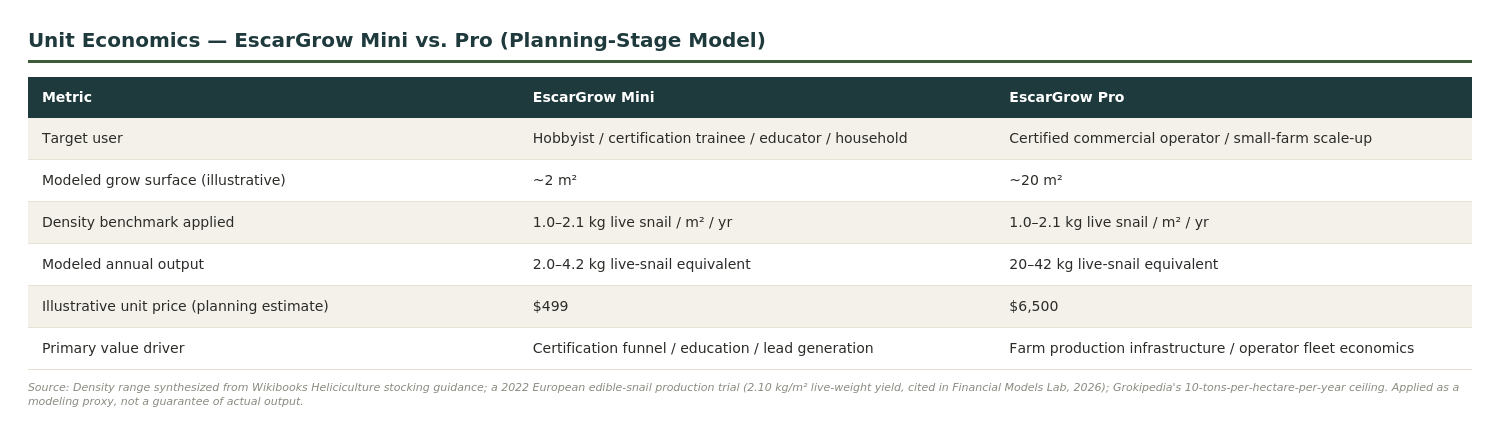
The figures below are a planning model, not measured performance data. Because EscarGrow's final production specifications are still under CAD development, we apply published heliciculture density benchmarks to two illustrative grow-surface scenarios. These numbers exist to give partners a transparent, checkable starting framework — and should be validated against EscarGrow's own pilot data before being relied upon for financial decisions.
Illustrative 3-Year Hardware Revenue Model
Unit pricing is a planning estimate pending a final manufacturer quote and bill-of-materials.

5. Designing Around APHIS Regulations
USDA APHIS classifies Cornu aspersum, the primary heliciculture species, as an invasive pest species. In practice, this restricts commercial sales to processed products, imposes permitting requirements on interstate movement of live snails, and requires state agricultural and APHIS concurrence before establishing a live-snail farm. This single regulatory fact shapes every downstream decision in this industry — site selection, containment design, sales channel, and insurance.
Source: USDA National Agricultural Library, “Snail Farming”; USDA APHIS PPQ 526 permitting guidance.
EscarGrow's sealed-bioreactor design treats this constraint as the design brief, not an obstacle to route around. A contained system that can demonstrate escape-proof housing gives certified operators, regulators, and partners a clear, auditable containment story — which is also, not incidentally, exactly what an insurer, a lender, or an investor wants to see before committing capital to a live-animal agricultural technology venture.
6. Organizational Structure
EscarGrow does not stand alone; it is the production-technology layer of a broader heliciculture ecosystem:
Helical Healing Habitat (HHH): a 501(c)(3) nonprofit and the organizational home for the mission, the EscarGrow Farmer Certification Program, and institutional partnerships.
EscarGrow LLC: A for-profit with license to the EscarGrow LP.
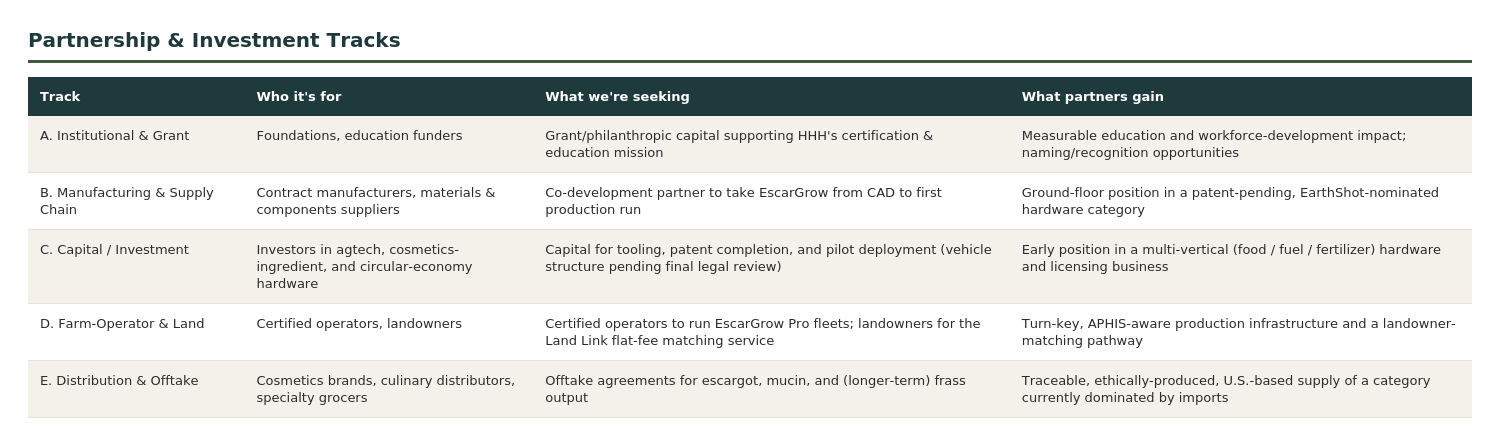
Because HHH is a nonprofit education and certification body, and EscarGrow is a hardware technology under patent-pending development, capital for the two tracks is intentionally kept separate: grant and philanthropic capital supports HHH's certification and education mission, while commercialization capital for EscarGrow hardware flows to a to-be-finalized commercial vehicle. Final legal structuring of that hardware vehicle is in progress and subject to attorney review before any investment is finalized.
Team
Ozi Manning: Founder, Inventor, and Escargot Farmer. 8+ years as a senior product designer (Fidelity, Jeep, Affinity Bands); founding product designer at Chill Jane.
Brian Manning:
Oleg Vereshchagin: Industrial Designer, leading EscarGrow hardware development and CAD/3D prototyping.
Khoury Howell: Director of Programming; platform architecture and civic-technology background; prospective independent board director.
Omar Gallaga: Secretary; 30-year journalism career; prospective independent board director.
7. Partnership & Investment Tracks
We are inviting partners across five distinct tracks. Each is structured to match the right kind of partner to the right kind of contribution and return.
8. What’s Next?
Secure a production manufacturer; finalize bill of materials and unit pricing; complete patent-pending legal review.
First production run and pilot deployment to an initial cohort of Farmer Certification Program graduates.
Integrate EscarGrow units as the hands-on hardware component of the Certified EscarGrow Farmer certification tier.
Scale manufacturing and distribution; pursue offtake agreements across food, cosmetics, and biofertilizer channels.
9. Risk Factors & Disclosures
EscarGrow Pro and Mini are patent-pending and currently at the CAD/3D prototype stage. No commercial units have been manufactured, field-tested at scale, or sold, and a production manufacturer has not yet been secured.
Market-size figures cited in this prospectus come from third-party industry research firms, whose methodologies vary and sometimes disagree substantially; they are provided for context and are not guarantees of future performance.
Unit-economics and revenue projections in Section 4 are an illustrative planning model based on published heliciculture density benchmarks, not measured EscarGrow field data, and are subject to change as pilot data becomes available.
Cornu aspersum is classified by USDA APHIS as an invasive species. Commercial sales are currently restricted to processed products, and interstate movement and facility permitting requirements apply. All operations must comply with applicable federal and state regulations.
The Giant African Land Snail (GALS) is federally prohibited in the United States and is not, and will not be, part of any EscarGrow product line or use case.
This document is provided for informational and discussion purposes only. It is not an offer to sell securities or a solicitation of an offer to buy securities. Any investment would be made only pursuant to definitive legal documentation and applicable securities law exemptions.
10. Contact
We built EscarGrow because heliciculture's biggest constraint is production. If you see a fit across manufacturing, distribution, land, institutional partnership, or capital, we would welcome the conversation.